The Autonomy Decision Matrix
A map for deciding how to automate. The two axes are capability and value.
The basic thesis was that we need to start with understanding technology capabilities (“could you do it?”) and marry that with user value (“should you do it?”).
Stef Hutka, The Newsletter Provides
Those questions became the axes of the Autonomy Decision Matrix in What Your Machines Should Do. An earlier version of the same pair of questions was the Cognitive Offloading Matrix.
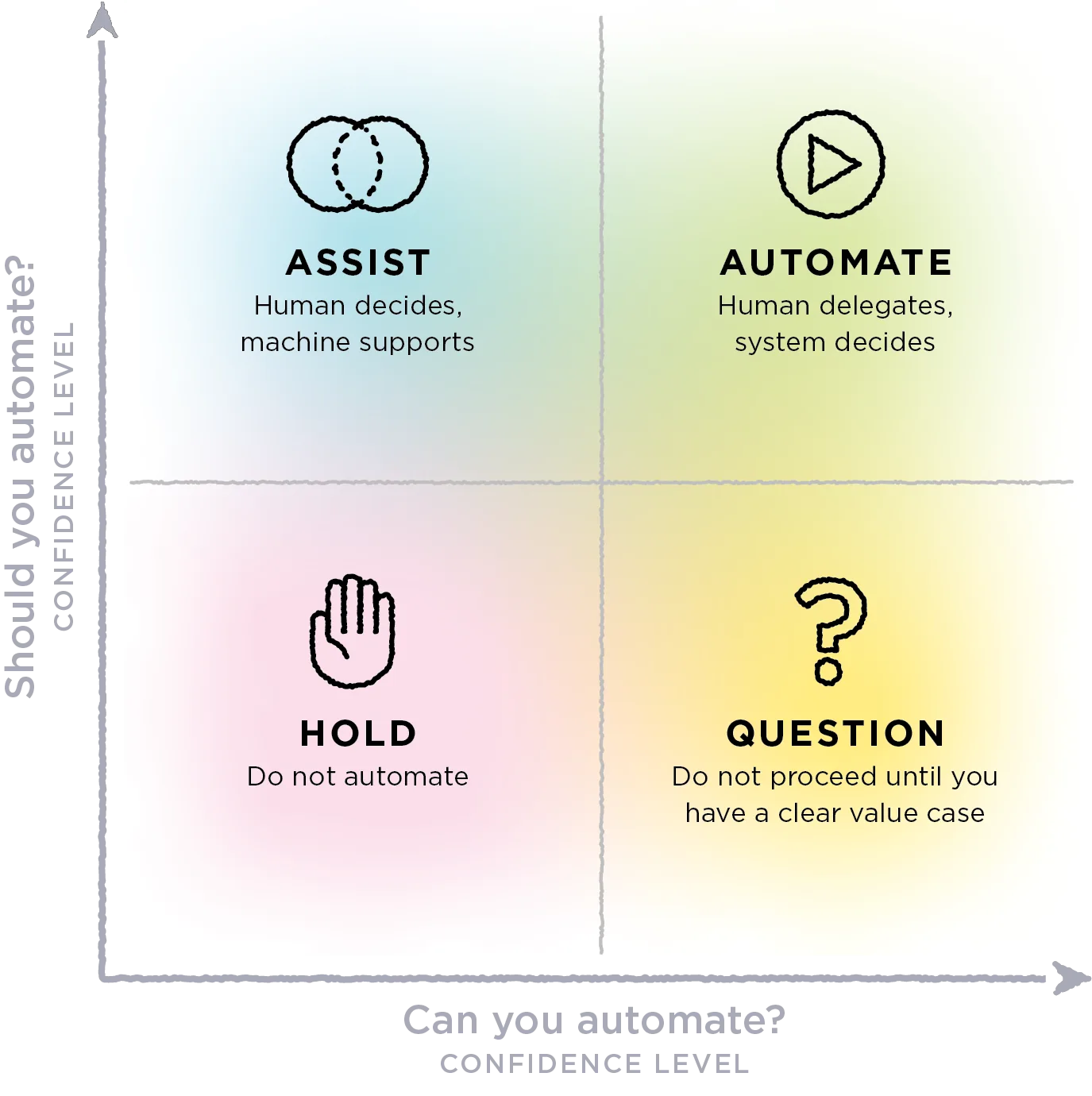
Assist
High value. Capability still catching up. Worth doing with a person in the loop, and more automation only as the technology proves out.
Automate
High value and high capability. You can move toward human-on-the-loop if the strategy and the oversight match the technology.
Hold
Value and capability are both still open. Not enough to invest further until one of those changes.
Question
You could automate this. The value is not there. The capability is real. It is not aimed at how you win.
Chapter 2 of the book is the Autonomy Decision Matrix. Chapters 3 and 4 are Could You Automate? and Should You Automate?
Where a person stays
We can map these as a spectrum: Manual —> HITL —> HOTL —> Fully Autonomous.
Stef Hutka, Automation is a Spectrum
HITL means the human remains the primary decision maker while the system carries out their plans. HOTL means the system can decide and act while a human supervises. Human in the loop and what to automate.
Book a call
A 30-minute scoping call.
Book a call